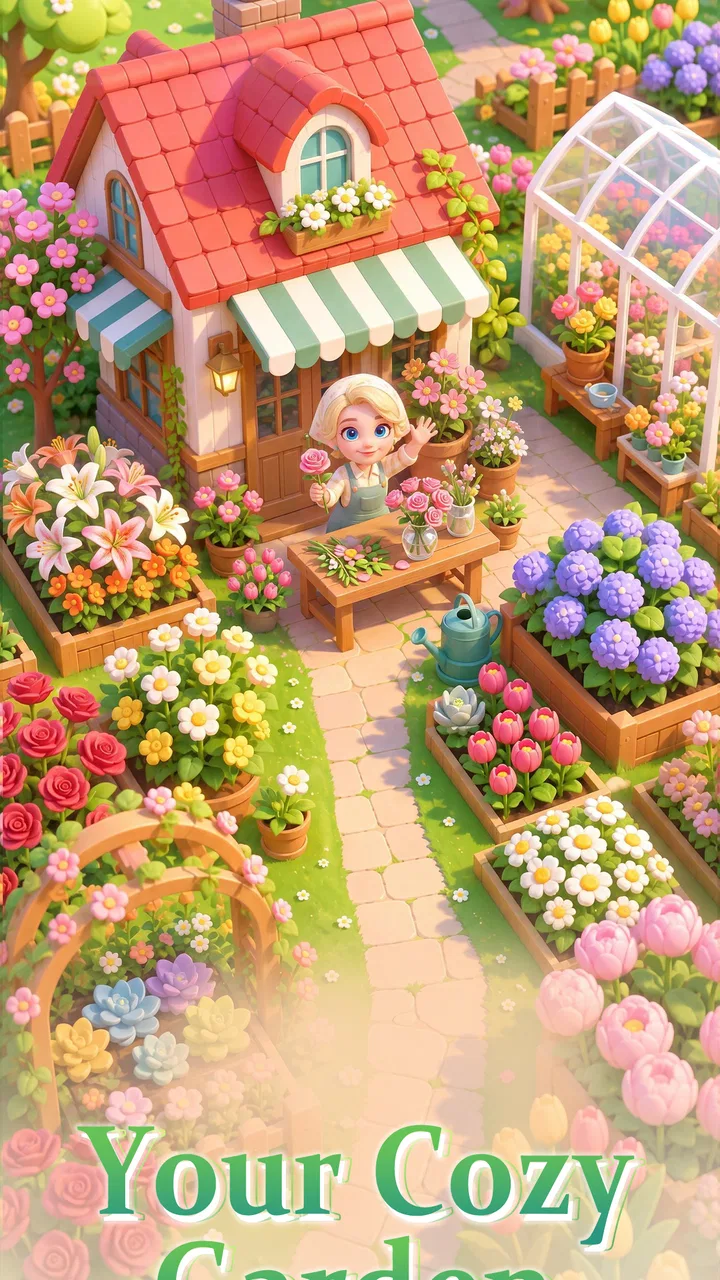
The Cozy Florist
- 4.7
- Rating
- 1.00M
- Installs
- Free
- Price

 Analysis by App-foxy
I went into The Cozy Florist expecting a gentle gardening game, and that is exactly the mood it creates: quiet, colorful, and easy to pick up when I only have a few minutes. Its central idea is unusually tangible for a mobile title, since the store summary says players can actually receive flowers while enjoying the gardening experience. That gives the game a warmer identity than a standard virtual garden, although the appeal depends on whether you want a relaxed simulation rather than a demanding management challenge.
Developed by Riftsky Games, this free simulation game is aimed at Everyone, so it is approachable for families and casual players. It has earned a 4.8 average from around 38 thousand ratings and passed 500 thousand installs, which suggests that the calm florist concept has found a substantial audience. I would recommend trying it if you like decorating, collecting, and checking in on a small project over time. I would be more cautious if you are looking for complex economics, fast competition, or a game built around constant action.
How the florist decisions shape each session
The most interesting part of the experience is not simply planting something and watching it grow. It is deciding what kind of session I want to have. Sometimes I treat the garden as a relaxing visual space and make choices based on what looks pleasant. At other times, I think more deliberately about which flowers deserve attention and how to make my next visit feel worthwhile. That small shift between decoration and planning gives the game more personality than its soft presentation initially suggests.
You May Also Like

 Blood Strike: 2.5 Anniversary
Blood Strike’s Loadouts Turn Every Drop Into a Tactical Gamble
A close look at Blood Strike’s custom loadouts: how fast access to signature weapons reshapes its battle royale rhythm, rewards preparation, and narrows the gap between fights.

 Pandora - Music & Podcasts
Pandora’s Music Is Easy to Start, but Harder to Recover
Pandora’s strength is its low-effort path from a seed to a station. Its weak spot is how much confidence it asks you to place in connection, setup, and quiet recovery.

 8 Ball Pool
 Is Built on Rivalries, Rematches, and Routine
A close look at the rivalries, rematches, shared routines, and unanswered safety questions that turn a quick pool match into a persistent mobile community.

 Samsung Music
’s Quiet Strength Is Playing What You Already Own
Its reach comes less from spectacle than from dependable access to a personal library. That simplicity is both the app’s strongest retention engine and its ceiling.

 AccuWeather: Weather Radar
AccuWeather Review: A Quick, Clear Forecast for Everyday Decisions
For everyday plans, the best forecast is the one you can understand quickly. AccuWeather makes rain timing, radar, and local conditions easy to act on, with a few trade-offs.

 Hill Climb Racing
Why Hill Climb Racing Still Turns Crashes Into One More Run
A tiny car, a bumpy hill and one more upgrade: Hill Climb Racing keeps resurfacing because its simple chaos makes every near-miss feel personal.
More From Our News Desk
View All News


A useful way to approach it is to give each visit a purpose. I might spend one session improving the overall look of the garden, then use the next to focus on progress rather than appearance. This prevents the game from becoming a repetitive sequence of tapping through the same routine. The florist theme also makes these decisions feel more coherent than they would in a generic farming simulator: I am not only growing items, but shaping the atmosphere and identity of a flower business.
The game works best when I resist the urge to rush every available action. A slower plan lets me notice which choices make the garden feel more personal and which ones merely create short-term movement. That is one of the first trade-offs I noticed. Immediate progress can be satisfying, but a garden arranged with a longer view often feels more rewarding when I return to it.
For a realistic everyday example, imagine opening the game during a lunch break. I would not try to complete everything in one sitting. I would check what needs attention, make one or two purposeful decisions, and leave with a clear idea of what I want to do later. In the evening, I could return when I have more time to adjust the presentation or continue the next stage of the garden. This rhythm suits people who enjoy small, repeatable tasks rather than long uninterrupted sessions.
Planning without turning a cozy game into homework
My best advice is to separate essential progress from optional decoration. If every visit becomes an attempt to perfect the entire garden, the relaxing tone can turn into pressure. I get more enjoyment by choosing one visible improvement and allowing the rest to wait. That approach also makes the game easier to fit around real life, because missing a long session does not make the whole experience feel wasted.
There is a subtle planning horizon here. A decision that looks minor during one visit can influence how satisfying the next few visits feel. I therefore try to avoid spending every available resource or opportunity immediately, especially when I am unsure whether I prefer a practical improvement or a visual one. The game does not need a complicated spreadsheet to reward this kind of thinking; it benefits from simply pausing before committing.
This is also where the game differs from many conventional farming alternatives. A farming game often emphasizes production chains, land expansion, or selling goods as efficiently as possible. The Cozy Florist feels more personal and presentation-focused. I am encouraged to care about the character of the space, not just the output. Players who enjoy arranging a scene may find that more appealing than maximizing a harvest.
On the other hand, someone who wants a deep economy may find the florist framing too gentle. I would choose a more system-heavy farming simulator if my main goal were optimizing income, balancing several production lines, or competing against strict timers. This game is better when the pleasure comes from gradual improvement and a pleasant setting.
Where patience pays off, and where spending changes the feel
The free entry point makes it easy to test the core loop without making a commitment. The game includes in-app purchases ranging from $0.99 to $99.99 per item, so I would advise deciding on a personal spending limit before getting deeply invested. That is not a criticism unique to this title; it is simply important in any free simulation where progress and customization can make optional purchases tempting.
I prefer to treat purchases as a convenience choice rather than part of the basic strategy. If I am enjoying the garden, I want my decisions to remain meaningful instead of solving every delay with a payment. A small purchase may feel reasonable for a player who wants to support Riftsky Games or speed up a particular part of the experience, while a larger purchase deserves more thought because it can reduce the satisfaction of planning around limited resources.
The key risk is not only financial. Spending too quickly can also flatten the game’s pacing. Waiting, choosing, and returning later are part of the cozy appeal. If convenience removes all of those pauses, the result may be faster but less engaging. I get more from the game when I allow the slower rhythm to do its job.
That said, patience should not mean forcing myself to continue when the routine stops being enjoyable. If I find that every visit feels like maintenance rather than relaxation, no purchase will fix the underlying mismatch. The right question is whether I like the decisions themselves, not whether I can make them happen faster.
The game’s Everyone rating makes it suitable for a broad audience, but I would still explain the purchase system to younger players and keep spending under adult control. The calm presentation can make the game feel completely consequence-free, yet optional purchases are still a real part of the experience. A simple household rule about spending is enough to preserve the game as a pleasant activity rather than an impulse-buying habit.
Adapting your approach as the garden develops
I found that the most useful adaptation is changing my priorities instead of repeating one fixed routine. Early on, I focus on learning the pace and understanding what makes a visit feel productive. Later, I pay more attention to how separate choices work together visually. This keeps the experience from becoming a checklist, because I am evaluating the garden as a whole rather than treating every action as isolated.
Another practical adjustment is to play according to my available attention. When I am tired, I use the game as a short calming break and make only low-pressure choices. When I am in the mood to plan, I spend longer considering the arrangement and the direction I want the florist to take. The same app can therefore serve two different purposes without needing a separate mode: a brief reset or a more thoughtful creative project.
This flexibility is one of its strongest qualities, but it also reveals a limitation. Players who need clear objectives, dramatic escalation, or constant novelty may interpret the open-ended feel as a lack of direction. I can enjoy a game that lets me set my own priorities, but I understand why another player might prefer stronger guidance. The Cozy Florist asks me to supply some of the motivation myself.
It is worth adapting expectations before downloading it. The store short description calls it “The Cozy Florist,” and that label is a good warning about its intended tone. I would not approach it expecting a competitive florist business simulation with detailed market pressure. I would approach it as a gentle gardening experience with a florist theme, where the value comes from returning to a space I have gradually shaped.
Compared with a pure decorating app, the gardening context gives my choices a sense of progression and timing. Compared with a traditional farming game, it feels less focused on industrial efficiency. Compared with a fast puzzle game, it offers far less immediate intensity. Those comparisons make the audience clearer: it sits between a creative relaxation app and a light simulation, rather than trying to dominate any one of those categories.
What keeps the experience interesting over time
Long-term enjoyment depends on whether I value gradual change. The game is not something I would install for one dramatic evening and then finish. Its appeal comes from seeing a small project become more recognizable through repeated visits. I like that the garden can become a personal record of my decisions, even when those decisions are simple.
To keep the experience fresh, I recommend setting small themes for different stretches of play. One period might be about making the garden feel bright and welcoming; another might focus on a more balanced arrangement. The point is not to invent systems that the game does not advertise, but to use its florist premise as a creative prompt. This gives each return a reason without demanding artificial competition.
A second useful habit is to take a moment before changing something that already works. In many simulation games, expansion is automatically treated as progress. Here, I find that preserving a pleasing arrangement can be just as valuable as adding something new. That creates a genuine trade-off between novelty and coherence. A crowded garden may offer more variety, while a simpler one may feel more intentional.
The game’s current version is 1.0.24, and it requires Android 6.0 or later. Those details matter if I am installing it on an older device, especially one that I use as a family tablet or spare phone. The broad compatibility is helpful, but I would still leave enough storage and keep the operating system reasonably current for a smoother experience.
Because it is free, I can also use a low-risk trial process. I would play without purchasing anything, see whether the return visits feel relaxing, and only then decide whether optional spending adds value. That is a better test than judging the game from its first few minutes. Cozy simulations often reveal their strengths through routine, while their weaknesses become clear when the routine starts feeling empty.
The biggest long-term question is whether the game offers enough meaningful variation for a player who wants constant discovery. I would recommend it more confidently to someone who enjoys steady, self-directed progress than to someone who needs a new challenge every session. Its strength is consistency, and consistency can feel either comforting or repetitive depending on the player.
My recommendation for different kinds of players
I think The Cozy Florist is a good fit for players who enjoy gardening themes, gentle decoration, and short sessions that can be revisited throughout the day. It is especially suitable for someone who wants a calm mobile game without an Everyone-inappropriate tone, or for a family looking for a soft simulation rather than an aggressive competitive title. The possibility of actually receiving flowers also gives the concept a distinctive emotional hook.
I would skip it if I wanted a demanding business simulator, deep resource mathematics, or a clearly defined campaign with a dramatic ending. I would also skip it if I dislike waiting, gradual progress, or making my own goals. In those cases, a more structured strategy game or a faster farming alternative would probably provide better value, even if it lacks this title’s warmth.
For me, the best way to play is to keep the pace intentional: check in when I genuinely want a quiet break, plan one meaningful improvement, and avoid treating optional purchases as a shortcut to enjoyment. That approach preserves the tension between immediate rewards and a garden that feels shaped over time.
Riftsky Games has made a simulation that understands the appeal of small, comforting routines. It is not trying to be the most complex game in the category, and that is both its identity and its boundary. I enjoy it most when I let the garden develop at its own pace, make choices for atmosphere as well as progress, and accept that a little patience is part of the experience.
My final verdict: try it if you want a free, friendly florist-themed game that turns short visits into a gradual creative project. The 4.8 average and strong install base show that many players connect with its approach, but popularity does not remove the need to choose carefully. For a relaxed gardening break, it is easy to recommend; for intense strategy or nonstop action, I would point you elsewhere.
FAQs for The Cozy Florist
01What is The Cozy Florist app about?
The Cozy Florist is a mobile application designed to help users create, manage, and enhance their floral arrangements. It offers a variety of tools for flower enthusiasts, including arrangement tutorials, color matching guides, and seasonal tips. The app is perfect for both beginners and experienced florists looking for inspiration and advice.
02Is The Cozy Florist available on both Android and iOS?
Yes, The Cozy Florist app is available for download on both Android and iOS platforms. You can find it on the Google Play Store for Android devices and the Apple App Store for iOS devices. Ensure that your device meets the minimum system requirements for optimal performance.
03Does The Cozy Florist require an internet connection to function?
While some features of The Cozy Florist app can be accessed offline, such as saved designs and guides, an internet connection is required for accessing new content, updates, and community features. It’s recommended to have a stable internet connection for the best experience.
04Are there any in-app purchases in The Cozy Florist?
The Cozy Florist app offers a range of features for free, but it also includes optional in-app purchases. These may include premium tutorials, exclusive floral designs, and advanced tools. Users can enjoy basic functionalities without any purchases, but the premium content enhances the app’s capabilities.
05Can I share my floral designs using The Cozy Florist?
Yes, The Cozy Florist app allows users to share their floral creations with others. You can easily export and share your designs through social media platforms or messaging apps. This feature is great for sharing your creative work with friends, family, or fellow florists in the community.
Pros
- Beautifully designed user interface.
- Wide variety of floral arrangements.
- Easy-to-use navigation and features.
- Seamless payment integration.
- Customization options for bouquets.
Cons
- Limited delivery regions available.
- Occasional app crashes reported.
- No offline access to designs.
- Limited customer service hours.
- Higher pricing than some competitors.

The Cozy Florist
Gallery